
OKI
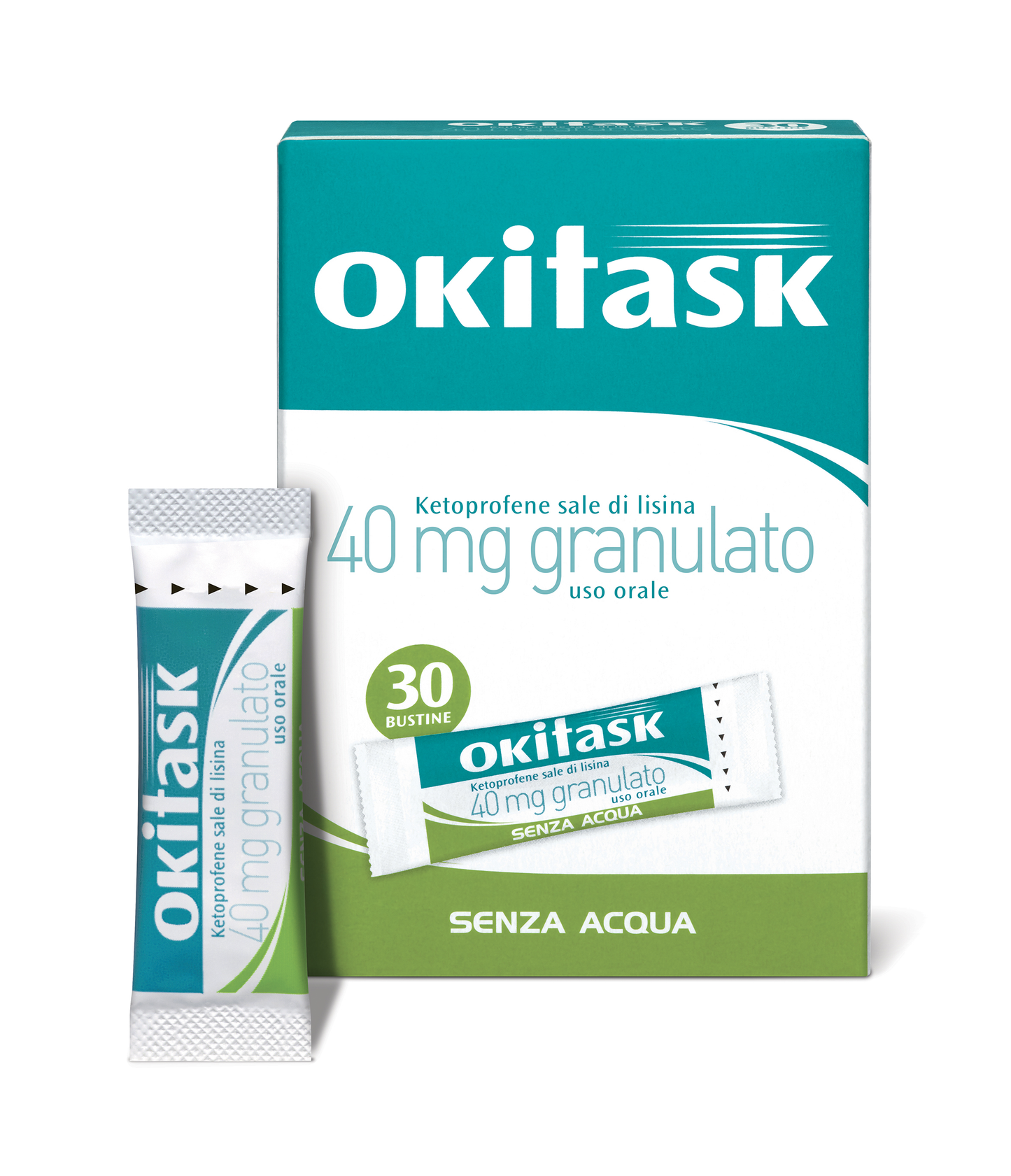
OKITASK 40 MG GRANULES 30 PET/AL/PE SACHETS
OKITASK 40 MG GRANULES 30 PET/AL/PE SACHETS

 Secure payment
 Discreet and sanitized package
 Fast and safe shipping


Description
Description
Okitask 40 mg granules
Ketoprofen lysine salt
What is it and what is it for?
Okitask contains ketoprofen, which belongs to a group of medicines called nonsteroidal anti-inflammatory drugs (NSAIDs). Ketoprofen blocks chemicals that cause inflammation.
Okitask is indicated for treating pain of various origins and natures, and in particular: headache, toothache, neuralgia (nerve pain), menstrual pain, muscle pain and osteoarticular pain (of the bones and joints).
Talk to your doctor if you do not feel better or if you feel worse after a few days of treatment.
What you need to know before taking the medicine
Do not take Okitask
- if you are allergic to ketoprofen, to other non-steroidal anti-inflammatory drugs (NSAIDs) or to any of the other ingredients of this medicine (listed in section 6);
- if you have a history of hypersensitivity (allergy) reactions triggered by the use of ketoprofen or substances with a similar mechanism of action, for example acetylsalicylic acid or other NSAIDs (other anti-inflammatory drugs) such as asthma (bronchial inflammation and narrowing of the airways), bronchospasm (constriction of the bronchi), allergic rhinitis (inflammation of the nasal mucosa of an allergic nature), urticaria, skin rashes, nasal polyps, angioneurotic edema (swelling of the skin and mucous membranes) or other allergic-type reactions;
- if you suffer from bronchial asthma (bronchial inflammation and narrowing of the airways);
- if you have severe heart failure (inability of the heart to pump an adequate amount of blood to meet the body's needs);
- if you suffer from gastritis (an inflammation of the stomach lining);
- if you currently have a peptic ulcer (a sore in the stomach or upper intestine) or bleeding, or if you have had recurrent peptic ulcer or bleeding in the past (two or more distinct, proven episodes of bleeding or ulceration);
- if you have had gastrointestinal bleeding (bleeding from the stomach or intestines), ulceration, perforation or chronic dyspepsia (difficult digestion) in the past;
- if you have a history of gastrointestinal bleeding or perforation following previous NSAID therapy;
- if you suffer from Crohn's disease (inflammation of the intestine) or ulcerative colitis (inflammation of the intestine with ulcers);
- if you have severe liver failure (reduced liver function due to liver cirrhosis, severe hepatitis) or renal failure (reduced kidney function);
- if you suffer from leukopenia (reduction in the number of white blood cells) or thrombocytopenia (reduction in the number of platelets);
- if you suffer from haemorrhagic diathesis (predisposition to developing haemorrhages) and other coagulation disorders or if you have haemostatic disorders (difficulty stopping bleeding);
- if you are taking high doses of diuretics;
- if you are in the third trimester of pregnancy;
- if the subject to be treated is under 15 years of age.
Warnings and precautions
Talk to your doctor or pharmacist before taking Okitask.
Warnings
Undesirable effects may be minimised by using the lowest effective dose and for the shortest duration necessary to control symptoms (see "How to take Okitask" and the sections below on gastrointestinal and cardiovascular risks).
Concomitant use of Okitask with other anti-inflammatory drugs should be avoided.
Gastrointestinal bleeding, ulceration, and perforation, which can be fatal, have been reported with all NSAIDs, such as Okitask, at any time during treatment, with or without warning symptoms or a previous history of serious gastrointestinal events. Patients with a history of these conditions are at increased risk (see "Do not take Okitask").
Report any abdominal signs or symptoms (including gastrointestinal bleeding) even at the start of treatment. Tell your doctor if you are taking medicines that may increase the risk of ulceration or bleeding, such as oral corticosteroids (medicines used to treat inflammatory conditions), anticoagulants (medicines that slow blood clotting) such as warfarin, selective serotonin reuptake inhibitors (medicines used to treat depression), or antiplatelet agents (medicines that prevent platelets from clumping together) such as acetylsalicylic acid (see "Other medicines and Okitask").
Elderly people are at increased risk of developing adverse reactions to NSAIDs, especially gastrointestinal bleeding and perforation, which can be fatal.
Discontinue treatment with Okitask immediately at the first signs of gastrointestinal bleeding or ulceration.
Serious skin reactions, some of them fatal, such as exfoliative dermatitis, Stevens-Johnson syndrome, and toxic epidermal necrolysis, have been reported very rarely in association with the use of NSAIDs (see "Possible side effects"). The reaction occurs most often in the early stages of treatment. Discontinue use of Okitask if you experience a rash, mucosal lesions, or any other sign of hypersensitivity (allergic reaction).
Precautions
Ask your doctor or pharmacist for advice before taking Okitask:
- if your kidneys are not working properly, as Okitask should be used with caution. If you use Okitask, you should monitor your kidneys, especially if you are elderly or taking diuretics (medicines that lower blood pressure);
- if you have liver problems you should have regular check-ups;
- if you have an infection – see section “Infections” below;
- if you suffer from uncontrolled hypertension (high blood pressure), congestive heart failure (accumulation of fluid in the lungs, abdominal organs and peripheral tissues due to inadequate pumping function of the heart), established ischemic heart disease (heart disease that occurs following reduced blood flow due to a narrowing of the coronary arteries), peripheral arterial disease and/or cerebrovascular disease (disease of the arteries and vessels of the brain), as you should take Okitask only after careful consideration by your doctor;
- if you have risk factors for these conditions, for example if you have high blood pressure, diabetes (a disease caused by high blood glucose levels), hyperlipidaemia (high levels of fats in the blood), or if you smoke;
- if you have allergic reactions or have suffered from allergies in the past, as the medicine must be administered with caution;
- if you suffer from bronchial asthma (bronchial inflammation and narrowing of the airways) or with allergic diathesis (predisposition to the onset of allergies), chronic rhinitis (inflammation of the nasal mucosa) and allergic rhinitis (inflammation of the nasal mucosa of an allergic nature), chronic sinusitis and/or nasal polyposis;
- if you suffer from haematopoietic alterations (which modify the formation and maturation of blood cells), systemic lupus erythematosus (a disease of the immune system) or mixed connective tissue diseases, as Okitask must be used with caution;
- if you have hepatic porphyria (a rare blood disease characterised by the alteration of the activity of one of the liver enzymes), as the medicine could trigger an attack.
Some NSAIDs may be associated with an increased risk of arterial thrombotic events (e.g., heart attack or stroke). There are currently insufficient data to exclude such a risk for OKITASK.
An increased risk of atrial fibrillation (disturbance in the heart rhythm) has been reported with the use of NSAIDs.
Hyperkalaemia (an increase in the amount of potassium in the blood) may occur, especially if you suffer from diabetes, renal insufficiency and/or are taking medicines that can cause hyperkalaemia (see "Other medicines and Okitask"). In these circumstances, potassium levels should be monitored periodically.
Infections
Okitask may mask the symptoms of infections, such as fever and pain. Therefore, Okitask may delay adequate treatment of the infection, which could increase the risk of complications. This has been observed in bacterial pneumonia and bacterial skin infections related to chickenpox. If you take this medicine while you have an infection and the symptoms persist or worsen, contact your doctor immediately.
Contact your doctor if you experience any vision problems, such as blurred vision, as treatment should be stopped.
Possible side effects
Like all medicines, this medicine can cause side effects, although not everybody gets them.
The most commonly observed adverse events are gastrointestinal in nature.
The following adverse reactions have been observed with the use of ketoprofen in adults:
Common (may affect up to 1 in 10 people):
- dyspepsia (difficult digestion), nausea, abdominal pain and vomiting.
Uncommon (may affect up to 1 in 100 people):
- headache, dizziness, drowsiness;
- constipation, diarrhea, flatulence (passage of intestinal gas from the anus), gastritis (inflammation of the stomach mucosa);
- skin rash, itching and fatigue.
Rare (may affect up to 1 in 1,000 people):
- hemorrhagic anemia (reduction of hemoglobin in the blood, the substance that carries oxygen in the blood caused by bleeding);
- paresthesia (sensation of numbness, tingling);
- blurred vision (see "Warnings and precautions");
- tinnitus (persistent perception of noises in the ear);
- asthma (bronchial inflammation and narrowing of the airways);
- stomatitis (inflammation of the mucous membranes lining the mouth), peptic ulcer (lesion of the stomach or upper part of the intestine);
- hepatitis (inflammation of the liver), increased transaminases (increase in some enzymes that indicate liver function), increased bilirubin (a substance that indicates liver function);
- increased weight.
Very rare (may affect up to 1 in 10,000 people):
- edema (swelling) of the face and erythema (redness of the skin).
Frequency not known (frequency cannot be estimated from the available data):
- thrombocytopenia (reduction in the number of platelets), agranulocytosis (severe reduction in the number of a type of white blood cell), bone marrow failure (reduction in the production of blood cells by the bone marrow), haemolytic anaemia (reduction in the amount of haemoglobin in the blood, a substance that carries oxygen in the blood, caused by the destruction of red blood cells), leukopenia (reduction in the number of white blood cells), neutropenia (reduction in the number of a type of white blood cell), aplastic anaemia (reduction in the amount of haemoglobin in the blood, a substance that carries oxygen in the blood, caused by insufficient production of blood cells by the bone marrow), leukocytosis (increased number of white blood cells), thrombocytopenic purpura (presence of spots on the skin due to a reduction in the number of platelets);
- anaphylactic reaction (severe allergic reaction, including shock), hypersensitivity (allergy);
- jaundice (yellowing of the skin and whites of the eyes);
- depression, hallucination (perception of things that do not exist in reality), confusional state, altered mood, agitation, insomnia, convulsions (uncontrolled body movements), dizziness, dysgeusia (altered taste), tremor, dyskinesia (involuntary movements), syncope (fainting), hyperkinesia (involuntary and uncoordinated movements), periorbital edema (swelling around the eye), peripheral edema;
- chills, asthenia (weakness);
- heart failure (inability of the heart to pump the adequate amount of blood needed for the body's needs), atrial fibrillation (altered heart rhythm), palpitations (awareness of the heartbeat), tachycardia (increased number of heartbeats), hypertension (high blood pressure), hypotension (low blood pressure);
- vasodilation (dilation of blood vessels), vasculitis (inflammation of the vessels), including leukocytoplastic vasculitis (inflammation of small vessels);
- bronchospasm (constriction of the bronchi), especially in patients with known hypersensitivity to acetylsalicylic acid and other NSAIDs, rhinitis (inflammation of the nasal mucosa), dyspnoea (difficulty breathing), laryngeal edema (swelling of the throat due to fluid accumulation), laryngospasm (narrowing of the larynx), acute respiratory failure (one case, with a fatal outcome, has been reported in an asthmatic patient sensitive to acetylsalicylic acid);
- exacerbation of colitis (worsening of inflammation of the intestine), exacerbation of Crohn's disease (worsening of inflammation of the intestine), gastrointestinal haemorrhage (bleeding from the stomach or intestine), gastrointestinal perforation (sometimes fatal, especially in the elderly, see "Warnings"), gastric ulcer (stomach ulcer), mouth ulceration, duodenal ulcer (injury to the upper part of the intestine), duodenal perforation, heartburn, mouth oedema (swelling), pancreatitis (inflammation of the pancreas), melaena (presence of digested blood in the stool), haematemesis (vomiting blood), abdominal discomfort, colitis, hyperchlorhydria (excess acid in the stomach), gastric pain (stomach ache), erosive gastritis (severe inflammation of the stomach lining), tongue oedema (swelling of the tongue);
- photosensitivity reactions (sensitivity reaction to sunlight or UV lamps), alopecia (hair loss), urticaria, angioedema (swelling of the face, lips, mouth, tongue, or throat that may cause difficulty breathing and swallowing), bullous eruptions including Stevens-Johnson syndrome, Lyell syndrome, and toxic epidermal necrolysis (serious skin reactions), edema (fluid retention), exanthema (skin rash), maculopapular exanthema (patchy rash), purpura (purple spots on the skin due to abnormal accumulation of blood), acute generalized exanthematous pustulosis (skin rash with the formation of purulent collections), dermatitis (skin irritation);
- acute renal failure (decreased kidney function), tubulointerstitial nephritis, nephritis and nephritic syndrome (inflammation of the kidneys), nephrotic syndrome (kidney impairment resulting in loss of protein in the urine), glomerulonephritis (inflammatory disease of the kidneys), water/sodium retention with possible edema (accumulation of water and sodium causing swelling), acute tubular necrosis and renal papillary necrosis (severe kidney damage), oliguria (decreased urine production), abnormal kidney function test, hematuria (blood in the urine);
- aseptic meningitis (inflammation of the membranes covering the brain not caused by infection), lymphangitis (inflammation of the lymph vessels);
- hyperkalemia (increased amount of potassium in the blood), hyponatremia (decreased amount of sodium in the blood).
Following the instructions in the package leaflet reduces the risk of side effects.
Reporting of side effects
If you experience any side effects, including any not listed in this leaflet, talk to your doctor or pharmacist. You can also report side effects directly via the national reporting system at: https://www.aifa.gov.it/content/segnalazionireazioni-avverse .
By reporting side effects you can help provide more information on the safety of this medicine.
OKI
OKITASK 40 MG GRANULES 30 PET/AL/PE SACHETS
OKITASK 40 MG GRANULES 30 PET/AL/PE SACHETS
Couldn't load pickup availability
Product images are purely indicative and may not be fully representative of the packaging and product features, as they may vary in color, size, or content. Any decorations, gift wrapping, and items included in the images for product presentation purposes will not be shipped with orders. Product names, ingredients, and percentages indicated in the descriptions are purely indicative and may be subject to change or updates by the manufacturers. Due to the impossibility of updating these updates in real time, the photos and technical information of the products listed on farmaInnovation.it may differ from those shown on the label or otherwise disclosed by the manufacturers. The only identifying element is the MINSAN (Ministry of Health) code. Farmacia Barni, farmainnovation.it , does not guarantee the accuracy and timeliness of the information published and declines all responsibility for any errors, omissions, or failure to update it. farmainnovation.it assumes no responsibility for damages of any kind that may arise from accessing the published information.