
837S
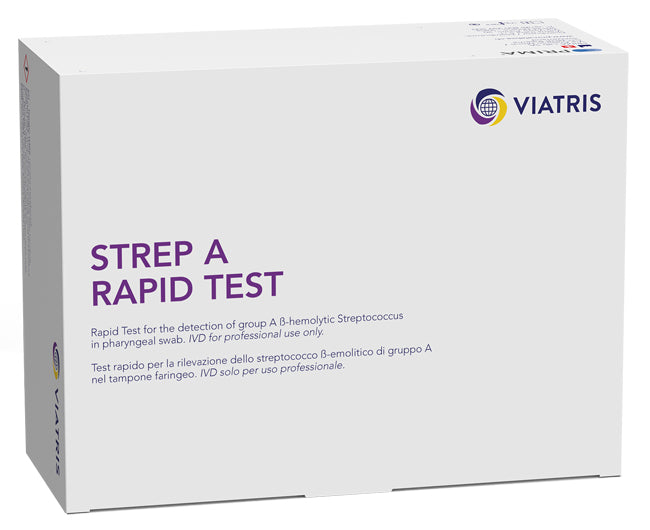
RAPID TEST FOR THE DETECTION OF HEMOLYTIC B STREPTOCOCCUS GROUP A BY PHARYNGEAL SWAB FOR PROFESSIONAL USE 20 PIECES
RAPID TEST FOR THE DETECTION OF HEMOLYTIC B STREPTOCOCCUS GROUP A BY PHARYNGEAL SWAB FOR PROFESSIONAL USE 20 PIECES

 Secure payment
 Discreet and sanitized package
 Fast and safe shipping


Description
Description
VIATRIS
STREP A RAPID TEST
Professional use
Rapid immunoassay for the qualitative and visual detection of Group A Streptococcus bacteria in throat infections. The test helps quickly determine whether the sore throat is caused by Group A Streptococcus rather than other pathogens (usually viruses) that may not require antibiotic treatment.
The test detects Strep A-specific antigens using special gold-conjugated antibodies incorporated into a test strip. The sample, a throat swab, is collected with a sterile, disposable rayon swab. The sample is placed in a plastic tube into which the operator inserts a specified volume of two extraction reagents (to extract Strep A-specific antigens). After an incubation period, the resulting sample solution is poured into the cassette's sampling well.
The reagents supplied are:
- R1: solution containing mainly sodium nitrite and phenol red.
- R2: solution containing mainly acetic acid.
When mixed, the two solutions create nitrous acid, which acts as an extractant of the Strep A-specific antigen.
If the Strep A concentration in the patient sample is equal to or greater than 104 CFU/mL, the specific antigens present in the sample solution are first bound by gold-labeled polyclonal anti-Strep A antibodies. The immune complexes are selectively captured by the test line (the T line, consisting of purified polyclonal anti-Strep A antibodies), resulting in the appearance of a red-purple band at the T line, indicating a positive result.
If Streptococcus A is absent or its levels in the patient sample are below the cutoff value (104 CFU/mL), a sufficient specific immune complex is not formed. Consequently, only one band, the C line, is visible, indicating a negative result.
As a procedural control, a colored band always appears in the control line area to indicate that the test procedure was performed correctly and that the test components and reagents performed as expected.
How to use
Sample collection and preparation
Bring tests, samples, and reagents to room temperature (15-30°C) before testing. To prevent cross-contamination, do not allow the tops of reagent bottles to come into contact with sample material.
Place the workstation on a flat, clean, and dry surface. Place the empty plastic test tube in one of the workstation's compartments.
Open the package containing the sterile swab. Avoid touching the cotton tip and remove the swab using the plastic handle. Ask the patient to tilt their head back and open their mouth as wide as possible. Take the tongue depressor in one hand and flatten their tongue. Use the other hand to place the swab near the throat. Touch the cotton tip to the back of the throat—the area around the tonsils and any red or sore areas (soft palate, uvula). It is recommended to rotate the swab because this increases the amount of sample collected.
It is recommended to process the collected swab samples as soon as possible after collection.
If swabs cannot be processed immediately, they should be placed in a sterile, dry, tightly closed tube or bottle and refrigerated. Do not freeze swabs. Swabs can be stored at room temperature (15-30°C) for up to 8 hours or refrigerated (2-8°C) for up to 72 hours.
All samples must be brought to room temperature (15-30°C) before being analyzed.
Test procedure
After collecting the sample, insert the cotton tip of the swab into the plastic tube provided, previously placed in the workstation.
Open vial R1 by unscrewing only the blue cap (leaving the white part tightly sealed), then add 4 drops to the test tube and close the cap. Then open vial R2 by unscrewing only the green cap (leaving the white part tightly sealed), then add 4 drops to the test tube and close the cap. Do not interchange reagent vial caps.
Holding the swab by the plastic handle, rotate it against the sides of the tube approximately 10 times to thoroughly mix the solution. Allow the swab to incubate for 2–5 minutes. At the end of the incubation period, remove the tube (with the swab and extraction fluid still inside) from the workstation. Using your thumb and forefinger, squeeze the sides of the tube to expel as much liquid as possible from the cotton tip of the swab and collect it in the tube. Remove the swab. Dispose of the swab according to infectious agent handling guidelines and place the tube in one of the workstation compartments.
Attach the supplied dropper to the plastic tube. Dispense 1 drop into the well of the test cassette. If the dispensed drop contains air bubbles, add another drop to the well.
Read the results after 5 minutes (some positive results may be observed after just 1 minute). Do not read after 10 minutes.
Interpretation of the results
The intensity of the colors of the lines is not relevant for the interpretation of the test results.
POSITIVE: Two colored lines appear. One colored line should always appear in the control region (C) and another in the test region (T). This means that the test has detected the presence of Strep A-specific antigens in the sample.
NEGATIVE: A colored line appears in the control line region (C). No visible colored line appears in the test line region (T). This is a negative result and means that no Strep A antigens were detected in the throat specimen or that they were present in quantities too low to be detected.
INVALID: No line appears, or a line appears only under the T (test) mark and not under the C (control) mark. In this case, the test result cannot be interpreted and should be considered invalid. Review the procedure and repeat the test with a new cassette. If the problem persists, immediately discontinue use of the test kit and contact the distributor. Insufficient sample volume, incorrect operating procedure, or expired tests are the most likely reasons for the control line not appearing.
Warnings
Read the instructions for use carefully before performing the test. The test is reliable if the instructions are followed correctly (reaction times, sample collection method, and extraction instructions indicated).
Do not use the test after the expiration date or if the package is damaged.
In vitro diagnostic device for professional use.
The test is for external use only. Do not ingest solutions R1 and R2 or any other package insert. If swallowed, seek medical advice immediately. Show the remaining parts of the box, instructions for use, and packaging.
If liquids come into contact with eyes, skin, or other mucous membranes, rinse immediately with plenty of water and seek medical attention. Show the vial labels.
After use, dispose of all components according to local regulations. Liquid waste should not be disposed of down the drain.
Do not open the sealed components (test cassette, swab, and tongue depressor) until you are ready to perform the test. Be sure to open them as directed.
Do not interchange reagent vial caps and do not mix components from different test kits.
All components of the kit are single use, with the exception of the workstation (which can be reused), the instructions for use and solutions 1 and 2, which must be stored, closed with their respective caps, at a temperature between 4°C and 30°C.
The operator is required to comply with local regulations in force and to operate in accordance with good laboratory practices (GLP). Do not eat, drink or smoke in the area where samples and test kits are handled.
Avoid cross-contamination of samples by using a new extraction tube for each sample obtained.
Handle all specimens as if they contain infectious agents. Observe established microbiological precautions throughout the procedure and follow standard procedures for proper specimen disposal.
The test procedure and interpretation of results must be followed carefully. Correct sample collection is essential for optimal test performance. Failure to follow the procedure may result in inaccurate results.
The test should be used only to detect Strep A antigen in throat swabs. It cannot determine either the quantitative value or the percentage increase in Strep A antigen concentration.
The test indicates only the presence of Strep A antigen in the sample due to the presence of viable or non-viable Group A Streptococcus bacteria and does not differentiate asymptomatic carriers of Group A Streptococcus from those with symptomatic infection.
The accuracy of the test depends on the quality of the swab sample collected. Improper sample collection or storage can result in false negative results. Negative results can also occur at the onset of the disease due to low antigen concentrations.
Excessive blood or mucus on the swab can interfere with the test results and lead to a false positive. Avoid contact of the swab with the tongue, cheeks, teeth, and any open wounds on the oral cavity when collecting the sample.
As with all diagnostic tests, results must be interpreted in light of the patient's overall medical history.
If the reading time (5 minutes) is not strictly respected, the results obtained may be incorrect.
Respiratory infections, including pharyngitis, can be caused by streptococci of serogroups other than group A and by other pathogens. A negative test result for group A streptococcus does not exclude infection by other pathogens. Positive results do not exclude co-infection with other pathogens.
If clinical signs and symptoms are inconsistent with the test results, further testing using other clinical methods (e.g., bacterial culture) is recommended.
The use of antibiotics or over-the-counter medications can suppress the growth of group A streptococcus in culture, despite the presence of organisms detectable with rapid antigen tests. This may lead to discrepancies in results.
Conservation
Store test components at 4°C to 30°C. Do not freeze.
Shelf life when packaged intact: 30 months.
Format
The kit contains:
- 20 hermetically sealed aluminum pouches containing: 1 test cassette and 1 desiccant sachet;
- 20 sterile swabs;
- 20 sterile wooden tongue depressors;
- 1 workstation;
- 20 empty plastic extraction tubes with droppers;
- 1 dropper bottle of R1 solution (containing enough solution to perform 20 tests);
- 1 dropper bottle of R2 solution (containing enough solution to perform 20 tests);
- 1 instruction sheet for use.
Bibliography
1. Anjos LM, Marcondes MB, Lima MF, Mondelli AL, Okoshi MP, Streptococcal acute pharyngitis, Rev Soc Bras Med Trop 2014; 47(4):409-13;
2. Castro SA, Dorfmueller HC A brief review on Group A Streptococcus pathogenesis and vaccine development, R Soc Open Sci 2021;
3. Centers for Disease Control and Prevention. Adult appropriate antibiotic use summary; http://www.cdc.gov/getsmart/community/materials-references/print-materials/hcp/adultapprop- summary.pdf. Accessed March 8, 2016;
4. Banerjee S, Ford C. “Rapid Tests for the Diagnosis of Group A Streptococcal Infection: A Review of Diagnostic Test Accuracy, Clinical Utility, Safety, and Cost-Effectiveness.” Ottawa (ON): Canadian Agency for Drugs and Technologies in Health; 2018 May. CADTH Rapid Response Reports;
5. Llor C, Bjerrum L, Munck A, Cots JM, Hernández S, Moragas A; HAPPY AUDIT Investigators. “Access to point-of-care tests reduces the prescription of antibiotics among antibioticrequesting subjects with respiratory tract infections.” Breathe Care. 2014 Dec;
6. Georgers N. Nakhoul,MD and John Hickner,MD,MSc, Management of Adults with Acute Streptococcal Pharyngitis: Minimal Value for Backup Strep Testing and Overuse of Antibiotics, J Gen Inter Med. 2013 Jun, 28(6):830-834;
7. Emily H. Stewart, Brian Davis, B. Lee Clemans-Taylor, Benjamin Littenberg, Carlos A. Estrada, and Robert M. Centor, Rapid Antigen Group A Streptococcus Test to Diagnose Pharyngitis: A Systematic Review and Meta-Analysis, PLoS One. 2014; 9(11);
8. Parks T, Barrett L, Jones N. Invasive streptococcal disease: a review for clinicians. British Medical Bulletin, Volume 115, Issue 1, September 2015, Pages 77–89.
Cod. 800060-20P
837S
RAPID TEST FOR THE DETECTION OF HEMOLYTIC B STREPTOCOCCUS GROUP A BY PHARYNGEAL SWAB FOR PROFESSIONAL USE 20 PIECES
RAPID TEST FOR THE DETECTION OF HEMOLYTIC B STREPTOCOCCUS GROUP A BY PHARYNGEAL SWAB FOR PROFESSIONAL USE 20 PIECES
Couldn't load pickup availability
Product images are purely indicative and may not be fully representative of the packaging and product features, as they may vary in color, size, or content. Any decorations, gift wrapping, and items included in the images for product presentation purposes will not be shipped with orders. Product names, ingredients, and percentages indicated in the descriptions are purely indicative and may be subject to change or updates by the manufacturers. Due to the impossibility of updating these updates in real time, the photos and technical information of the products listed on farmaInnovation.it may differ from those shown on the label or otherwise disclosed by the manufacturers. The only identifying element is the MINSAN (Ministry of Health) code. Farmacia Barni, farmainnovation.it , does not guarantee the accuracy and timeliness of the information published and declines all responsibility for any errors, omissions, or failure to update it. farmainnovation.it assumes no responsibility for damages of any kind that may arise from accessing the published information.