
VIVIN
VIVIN C "330 MG + 200 MG EFFERVESCENT TABLETS" 20 TABLETS"
VIVIN C "330 MG + 200 MG EFFERVESCENT TABLETS" 20 TABLETS"

 Secure payment
 Discreet and sanitized package
 Fast and safe shipping


Description
Description
VIVIN C 330 mg/200 mg effervescent tablets
Acetylsalicylic acid/ascorbic acid
What is it and what is it used for?
VIVIN C contains the active ingredients acetylsalicylic acid (a prostaglandin synthesis inhibitor with anti-inflammatory and analgesic activity) and ascorbic acid (vitamin C).
VIVIN C is used in adults for the symptomatic treatment of:
- headache and toothache, neuralgia (severe pain caused by irritation of one or more nerves), menstrual pain (associated with the menstrual cycle), rheumatic pain (of the joints) and muscular pain (of the muscles);
- feverish states and flu and cold syndromes.
Contact your doctor if you do not feel better or if you feel worse after 3 days of use at the maximum dose or after 5 days of continuous use.
What you need to know before taking the medicine
Do not take VIVIN C:
- if you are allergic to the active substances (acetylsalicylic acid and ascorbic acid), to other analgesics (painkillers)/antipyretics (fever relievers)/non-steroidal anti-inflammatory drugs (NSAIDs) or to any of the other ingredients of this medicine (listed in section 6);
- if you have a known tendency to haemorrhage (loss of blood from blood vessels);
- if you suffer from gastropathies (stomach diseases), for example gastroduodenal ulcer (lesion that occurs in the stomach or the first part of the intestine);
- if you have asthma (narrowing of the lower airways resulting in breathing difficulties);
- if you have a history of gastrointestinal bleeding (in the stomach and intestines) or perforation (serious injury to the wall of the stomach or intestine) related to previous active treatments (directed immediately to treat an illness or injury);
- if you have a history of recurrent bleeding or peptic ulcer (erosion of the inner lining of the stomach, intestine or lower oesophagus) (two or more distinct episodes of proven ulceration or bleeding);
- if you suffer from severe renal (decreased kidney function), cardiac (heart) or hepatic (liver) insufficiency;
- if you are taking methotrexate (at doses of 15 mg/week or more) or warfarin (see "Other medicines and VIVIN C");
- if you are in the last three months of pregnancy, do not take a dose of acetylsalicylic acid higher than 100 mg per day (see "Pregnancy, breastfeeding and fertility");
- if you are breastfeeding.
This medicine is also contraindicated in children and adolescents under 16 years of age (see "Children and adolescents").
Warnings and precautions
Talk to your doctor or pharmacist before taking VIVIN C.
Avoid taking VIVIN C in combination with other NSAIDs (non-steroidal anti-inflammatory drugs), including selective COX-2 inhibitors, such as colecoxib, valdecoxib, lumiracoxib, etc. (see "Other medicines and VIVIN C").
Take VIVIN C with caution if:
- are taking concomitant medicines that could increase the risk of ulceration or bleeding, such as oral corticosteroids (medicines used as anti-inflammatories and in some cases of allergic reactions), anticoagulants (medicines that inhibit blood clotting), selective serotonin reuptake inhibitors (SSRIs, medicines used to treat depression or obsessive-compulsive disorder), or antiplatelet agents (which reduce the aggregation of platelets) such as aspirin (see "Other medicines and VIVIN C") or if you are taking heparins;
- have had a gastrointestinal disease such as ulcerative colitis or Crohn's disease (chronic inflammatory bowel disease) in the past, as these conditions may be exacerbated (made worse) (see section 4 "Possible side effects");
- if you have a history of hypertension (high blood pressure) and/or heart failure, as fluid retention (a tendency to retain fluid in the body) and edema (accumulation of fluid in the tissues) have been reported in association with NSAID therapy. The risk is greater in patients treated with diuretics.
It is advisable to consult your doctor if you have :
- glucose-6-phosphate dehydrogenase deficiency (an enzyme whose genetically determined absence leads to a disease characterized by reduced red blood cell survival);
- gastric and intestinal disorders;
- reduced kidney function (mild to moderate reduction in kidney function);
- any unusual gastrointestinal symptoms (especially gastrointestinal bleeding), particularly in early treatment;
- if you are in the first or second trimester of pregnancy (see "Pregnancy, breastfeeding and fertility");
- if you are diabetic, as salicylates may increase the hypoglycaemic effect of sulfonylureas.
If gastrointestinal bleeding or ulceration occurs while taking VIVIN C, stop treatment immediately and do not restart without first consulting your doctor.
Stomach and intestinal bleeding, ulceration or perforation, which can be fatal, has been reported with all NSAIDs at any time during treatment, with or without warning symptoms or a history of serious gastrointestinal (GI) events.
The risk of gastrointestinal bleeding, ulceration, or perforation is greater with high doses of NSAIDs in patients who have had ulcers in the past, particularly if complicated by bleeding or perforation (see section 4 "Possible side effects"). People who drink large amounts of alcohol are at increased risk of bleeding.
In these cases, treatment should be initiated at the lowest available dose, and the possibility of using concomitant gastroprotective agents (e.g., misoprostol or proton pump inhibitors) should be considered. The use of gastroprotective agents should also be considered if low-dose acetylsalicylic acid or other drugs that may increase the risk of gastrointestinal events are being taken (see "Other medicines and VIVIN C").
Undesirable effects may be minimised by using the lowest effective dose for the shortest duration necessary to control symptoms (see section 3 "How to take VIVIN C").
Serious skin reactions, some of them fatal, including exfoliative dermatitis (severe erythema with peeling of the skin), Stevens-Johnson syndrome (a serious disease of the skin and mucous membranes often caused by an acute allergic reaction to drugs), and toxic epidermal necrolysis (the most severe form of Stevens-Johnson syndrome in which the skin peels off in sheets), have been reported very rarely in association with the use of NSAIDs (see section 4 "Possible side effects"). Patients appear to be at highest risk early in the course of therapy, with the onset of the reaction occurring in the majority of cases within the first month of treatment.
Stop treatment with VIVIN C at the first appearance of a skin rash (sudden reddening of the skin), mucosal lesions or any other sign of hypersensitivity (allergy) .
Acetylsalicylic acid and other NSAIDs can cause allergic reactions including asthma attacks, runny nose, angioedema (swelling of the skin and mucous membranes of the face), or urticaria (small, itchy spots on the skin).
In subjects with asthma and/or rhinitis (with or without nasal polyposis) and/or urticaria, reactions may be more frequent and severe.
Acetylsalicylic acid changes uricemia (the level of uric acid in the blood).
Surgery
If you are undergoing surgery (even minor surgery, such as tooth extractions) and have used acetylsalicylic acid or another NSAID in the previous few days, there is an increased risk of bleeding and you should inform your surgeon due to the possible effects on coagulation.
Metrorrhagia or menorrhagia: taking acetylsalicylic acid at the same time may increase the risk of greater intensity and duration of bleeding.
Children and adolescents
Taking VIVIN C is contraindicated in children and adolescents under 16 years of age (see "Do not take VIVIN C").
Cases of Reye's syndrome, a very rare but life-threatening condition that requires immediate medical attention, have been observed in children with viral infections (particularly chickenpox and flu-like conditions) treated with aspirin. This condition manifests itself with persistent vomiting and signs of progressive central nervous system damage, such as numbness (slowing of normal mental activity), convulsions (involuntary muscle contractions) and coma, signs of liver damage, and hypoglycemia (low blood glucose levels).
Elderly people
Elderly patients have an increased frequency of adverse reactions to NSAIDs, especially gastrointestinal bleeding and perforation, which may be fatal (see section 3 "How to take VIVIN C"). The risk is higher with increased doses of NSAIDs, therefore these patients should start treatment with the lowest available dose and the possibility of using concomitant gastro-protective agents (e.g. misoprostol or proton pump inhibitors) should be considered.
People over 70 years of age, especially if they are undergoing other treatments, should take this medicine only after consulting their doctor.
Possible side effects
Like all medicines, this medicine can cause side effects, although not everybody gets them.
Most side effects are dependent on both the dose and the duration of treatment.
The most common side effects that may occur following the intake of VIVIN C are of a gastrointestinal nature:
- nausea, vomiting, diarrhoea, flatulence (gas in the gastrointestinal tract), constipation (difficulty emptying the bowel), dyspepsia (pain or discomfort in the upper abdomen associated with eating), abdominal pain, ulcerative stomatitis (severe inflammation of the oral mucosa, characterised by the presence of ulcers on the cheeks, tongue and lips), exacerbation of colitis (inflammation of the part of the intestine called the colon) and Crohn's disease (see "Warnings and precautions");
- peptic ulcer (erosion of the inner lining of the stomach, intestine or lower esophagus), even perforated;
- gastrointestinal bleeding, which may manifest as hematemesis (vomiting blood) and melena (blood in the stool), and can sometimes be fatal, or remain occult (i.e., does not manifest itself) and cause iron deficiency anemia (a reduction in the amount of haemoglobin resulting from iron deficiency); such bleeding is more frequent as the dosage increases, particularly in elderly patients (see "Warnings and precautions");
- gastritis (less frequently).
Other side effects that may occur following the intake of VIVIN C are :
- edema (accumulation of fluid in the body's tissues), hypertension and heart failure;
- bullous reactions (with the formation of blisters on the skin), up to the most serious ones such as Stevens-Johnson syndrome and toxic epidermal necrolysis (see "Warnings and precautions");
- bleeding disorders, such as epistaxis (nosebleeds), gum bleeding, thrombocytopenia (low blood platelet count), purpura (a bleeding disorder characterized by the appearance of reddish-purple spots that do not disappear when pressed), with increased bleeding time; this effect may last for 4-8 days even after stopping VIVIN C administration and may cause a risk of bleeding in patients undergoing surgery;
- chronic hemolysis (destruction of red blood cells caused by increased amounts of vitamin C in the body, exceeding 1 gram), in patients with G6PD deficiency;
- hypersensitivity (allergy) reactions such as angioedema (rapid swelling of the tissues under the skin and under the mucous membranes), Quincke's edema (rapid swelling of the tissues of the face, hands, feet, genitals and mucous membranes), urticaria (a skin rash characterised by the appearance of raised lesions usually accompanied by itching), erythema (redness and burning sensation of the skin), asthma, anaphylactic reactions (rapidly appearing allergic reactions);
- ringing in the ears (tinnitus), sensation of decreased hearing, headache, dizziness;
- delayed delivery;
- formation of oxalate and uric acid stones in the kidneys and urinary tract caused by high doses of vitamin C (greater than 1 gram);
- rhinitis (runny nose), dyspnea (difficulty breathing);
- bronchospasm (abnormal contraction of the smooth muscles of the bronchi or bronchioles), asthma attacks.
Reporting of side effects
If you experience any side effects, including any not listed in this leaflet, talk to your doctor or pharmacist. You can also report side effects directly via the national reporting system at: https://www.aifa.gov.it/content/segnalazionireazioni-avverse .
By reporting side effects you can help provide more information on the safety of this medicine.
VIVIN
VIVIN C "330 MG + 200 MG EFFERVESCENT TABLETS" 20 TABLETS"
VIVIN C "330 MG + 200 MG EFFERVESCENT TABLETS" 20 TABLETS"
Couldn't load pickup availability
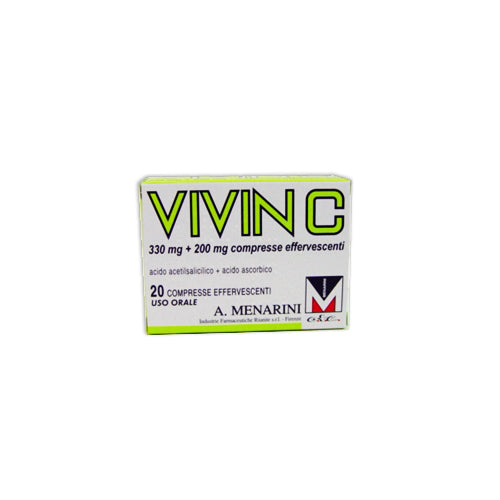
Product images are purely indicative and may not be fully representative of the packaging and product features, as they may vary in color, size, or content. Any decorations, gift wrapping, and items included in the images for product presentation purposes will not be shipped with orders. Product names, ingredients, and percentages indicated in the descriptions are purely indicative and may be subject to change or updates by the manufacturers. Due to the impossibility of updating these updates in real time, the photos and technical information of the products listed on farmaInnovation.it may differ from those shown on the label or otherwise disclosed by the manufacturers. The only identifying element is the MINSAN (Ministry of Health) code. Farmacia Barni, farmainnovation.it , does not guarantee the accuracy and timeliness of the information published and declines all responsibility for any errors, omissions, or failure to update it. farmainnovation.it assumes no responsibility for damages of any kind that may arise from accessing the published information.